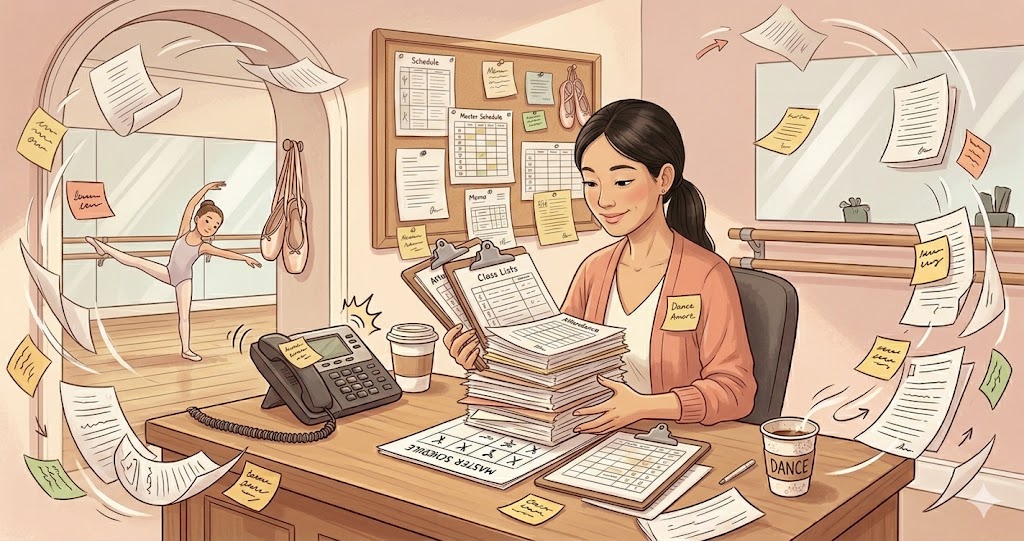
Quick summary
- Keep classes, attendance, and parent updates in one operating rhythm.
- Define one source of truth for schedules, absences, and family communication.
- Parents notice organization long before they notice software.
Most dance school admin problems do not start with a major crisis. They start when a parent misses a schedule change, a teacher marks attendance in the wrong place, and the owner has to piece the week back together late at night.
If class schedules live in one spreadsheet, attendance in another, and parent communication in chat threads, the problem is not effort. The problem is fragmentation.
The goal is not to work harder. The goal is to make classes, attendance, and follow-ups live in the same operating system.
1) Start with one source of truth
Choose one place where every active student, family, class assignment, and attendance record is updated first. If staff write information in multiple tools and clean it up later, later becomes never.
For most dance schools, the minimum source of truth is: student record, parent contact, class assignment, teacher, room, and latest attendance status.
2) Organize classes before the week starts
The weekly mess usually starts because the real schedule lives in the owner's head instead of in a shared workflow. Decide in advance who teaches, where each class runs, what happens with make-up lessons, and how parents are informed about changes.
Parents can handle a firm policy more easily than a policy that changes every week.
3) Connect attendance to parent follow-up
Attendance should not be a separate ritual that nobody looks at again. If a student has repeated absences or inconsistent attendance, the front desk should see that immediately and know whether to follow up with the family.
A clean attendance record is not just a teaching tool. It helps you spot churn risk, parent confusion, and class-planning issues earlier.
4) Make parent communication predictable
Good communication is not about writing warmer messages. It is about reducing ambiguity. Parents should know where schedule updates appear, how absences are reported, and how the school shares important notices.
One communication flow beats five half-maintained channels.
5) Review exceptions weekly
Create one weekly exception review for repeated absences, class changes, trial students, and unresolved parent follow-ups. That keeps the team proactive without turning every day into admin chase mode.
Final thought
A well-run dance school does not feel organized because the owner remembers everything. It feels organized because the process does.
Need the software side of this? See our Greek page for λογισμικό σχολής χορού.
Want to see the workflow in more detail? See how the process works for dance schools.
Related resources
- Dance school management software page - Commercial overview for tuition, attendance, and parent communication.
- How it works - Practical workflow for studio operations.
- Dance blog - More owner and parent-focused articles.
Sources & Further Reading
Parent communication
- European School Education Platform - Guidance on building clear and ongoing communication flows with parents.
- European School Education Platform - Overview of why strong parent involvement and information flow matters.
Dance school operations
- Cyprus Dance Association - Local Cyprus dance association context for professional dance teaching standards and member network.
- Niki School of Ballet - Concrete Cyprus example of how a dance school structures age groups, class durations, and progression paths.
Safe studio environment
- Council of Europe - Start to Talk - European safeguarding framework for keeping children safe in organized sport and activity settings.
- One Dance UK - Resource on responsible relationships and safeguarding in dance settings.
What to do next
If you want a dance school that feels organized for parents from the first interaction, keep the teaching warm and the operations clear.
Related reading

What Ballet Really Teaches Kids (Besides Pointing Their Toes)
A practical, funny look at how ballet helps kids build coordination, movement, focus, structure, and confidence.

How to Choose the Right Dance School for Your Child (Without Losing Your Mind)
A practical, opinionated guide to what actually matters when picking a dance school — and what you can safely ignore.

How to Handle Trial Classes and New Enrollments in a Dance School
A practical guide for dance school owners who want cleaner trial-class follow-up, fewer missed leads, and a smoother enrollment flow.
How to Reduce Parent Confusion Around Schedule Changes in a Dance School
A practical guide for dance school owners who want fewer missed messages, fewer timetable mistakes, and clearer communication when classes change.
What Software a Dance Academy or Studio Actually Needs
A practical guide for owners comparing tools for a dance academy or studio and trying to avoid a messy mix of spreadsheets, chats, and admin apps.

The Power of Ballet: What the Joburg Ballet School Story Shows
From apartheid exclusion to access in Soweto, Alexandra, and Braamfontein, this story shows how ballet can become a language of dignity, discipline, and opportunity.
Dance School Tuition Collections and Payment Reminders: A Practical Software Workflow
A practical guide for dance school owners who want fewer late payments, clearer tuition tracking, and calmer parent conversations around billing.
Dance School Attendance and Parent Communication: A Workflow That Actually Works
A practical workflow for studio owners who want attendance, absences, and parent updates to stay accurate without constant back-and-forth messages.

How to Increase Enrollment at Your Dance School (Without Paying for Ads)
A practical enrollment playbook for dance school owners: referral mechanics, a trial-class funnel that converts, the September window, and removing friction at sign-up.
Ballet Academy Software: What Actually Matters When You Choose
Ballet academies are not generic gyms: levels and exams, recital seasons, costume fees, and multi-class weeks. Here is what your software must model — and what you can ignore.

Excel or Software for Your Dance School? An Honest Comparison
When a spreadsheet is genuinely enough, where it breaks — payment status across months, parent questions, attendance history — and how to switch without losing your data.